
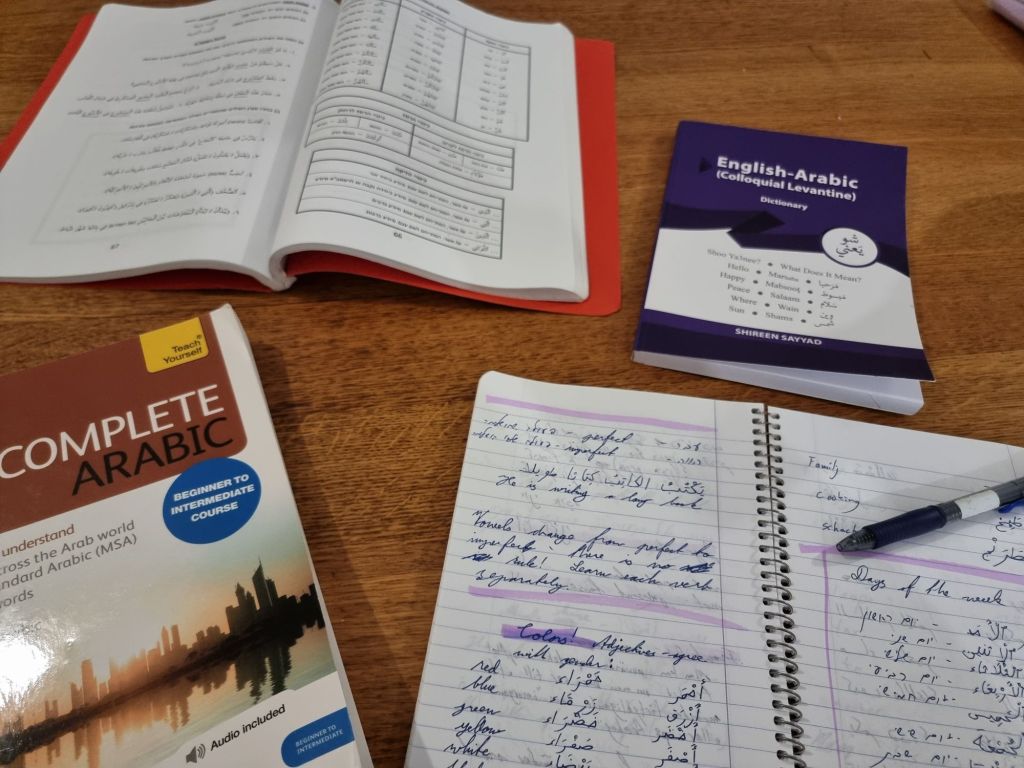
The past year, I’ve worked hard to improve my Arabic. I’m by no means fluent, but I’m at the top of the Duolingo course, and with some practice, I’m slowly getting there. When I walk my dog and meet people from the neighboring Arab village, I can conduct some extremely basic conversations, although I probably still sound like an idiot.
My wife has been studying Korean for the past year, taking a bigger interest in Korean food and culture, and I’m seeing that thrill of learning an entirely new language and alphabet and discovering a new part of the world. She says Korean is extremely interesting because of how different it is from every other language she has learned. She might pick up Japanese or Chinese next.
So I decided I wanted to take up Hindi. For now, I’m still just learning the alphabet, and it’s actually pretty cool. Since I already know four alphabets (Latin, Greek, Hebrew, and Arabic) so what’s another one? The cool thing is that if I learn Hindi, then learning Urdu, the language of Pakistan, will probably be relatively easy since I already know the Arabic alphabet.
I still haven’t given up on Ancient Greek – I read a few verses of the New Testament every day, and I hope to pick up Latin some day. I hope to one day be able to pick up Spanish and French too. And what’s up with that Amharic language in Ethiopia? Their alphabet can’t be that hard, can it…?
As you may have noticed, the ambition and the enthusiasm are there, but I have no bragging rights. I’ve failed most of my language learning goals. The only three I speak fluently (Swedish, English, Hebrew) are the same I spoke when I was 18, the ones that life circumstances forced me to learn.
Also, I don’t have time. But I figured that slow progress is better than no progress, so for the past year I’ve spent 5 to 10 minutes a day studying a language. Progress is extremely slow, but after a full year of it, I actually see that there is progress.
I have a tendency to pick up new shiny projects all the time. For now, I’m really trying to force myself to focus on the Arabic and not let anything else distract me. Well, except Hindi. And while doing all this, I’ve discovered that there are so many amazing benefits in learning new languages. Here are ten of the reasons why you – yes, you – should learn a foreign language.
1. It’s widening your horizons. Suddenly, the world is a lot bigger. For my books, I’m researching a lot of Israeli and Jewish history, and let me tell you – about half of all the material only exists in Hebrew. The inside stories and jokes of certain cultures, the puns, the memes, and the jokes – for each and every language you enter a whole new world.
2. You are forced to humility. You know how people who speak broken English seem as if they are more stupid than you? You know they’re not, but somehow it seems like it? When you learn a new language, you are putting yourself in that place. Once you start learning Spanish, that Mexican immigrant is the one who sounds smart, and you’re the one who sounds like an idiot. Embrace it. Whichever language you try to learn, the key is experience and talking to natives, and there’s no other way to do that than to risk seeming stupid. It takes courage and humility. Go for it.
3. The sense of accomplishment. There’s something to be said for the sense of accomplishment that comes with learning a new language. It’s empowering, and it’s an amazing thrill. The weird signs and sounds start to make sense. It’s no longer a scary and incomprehensible mess, it actually conveys ideas and thoughts.
4. Connections. You get closer to people who speak your target language. Most people are almost moved to tears when they hear that you’re trying to learn their language and do everything they can to help you. (Well, except the Americans and the French. They tend to look down on anyone who doesn’t speak their language perfectly). Speaking even some local language wherever you go will get you smiles, and people will be more prone to help you out. Here in Israel, for example, I know for a fact that Palestinians who speak Hebrew often get better treated by the Israeli soldiers at the checkpoints.
5. Practicality. Just imagine being able to read signs in a foreign language, food labels on food imported from somewhere, understand what people say about you behind your back when they think you don’t understand. It’s a skill that also makes you a lot more employable for a plethora of reasons. The tiny little benefits in ongoing daily life are numerous.
6. It forces you to be disciplined and organized. There are no shortcuts to learning a language. Your brain has to be focused, engaged, and consistent. You have to be intentional in how you spend your time, organize your studies, and be disciplined. These are all personality qualities that will spill over into other aspects of your life and they are all highly beneficial. Who wouldn’t want to be more intentional and disciplined in their lives? Defeat procrastination, get more done in a shorter amount of time, and have more free time to enjoy with the family. If you try to learn a language while not being disciplined, you won’t get anywhere.
7. Understanding thought patterns. Our thought patterns rely on the language we speak more than we think. The amazing thing here is that this is true for dead people, too. By learning ancient Greek or Hebrew, you’re not only increasing your knowledge, you’re actually reading the exact same words as Paul the Apostle or King David wrote. This is a huge benefit from learning old languages, also if it’s Aramaic, Latin, Egyptian, Akkadian, Sanskrit, Sumerian… the history comes a lot closer and you connect with these ancient people on a whole other level. Suddenly, the people of your target language, whether dead or alive, are no longer strangers, but regular people like you and me, with hopes and dreams and thoughts about life and death.
8. Which brings me to the next point – learning another language erases the de-humanization of that group. It’s so easy to think less of those Spanish-speaking immigrants, or those Arabs in the Middle East, or about those Chinese or North Koreans. Or at least, it’s easy to avoid thinking of them as humans. They are different, they are “the other.” But the moment you learn their language – wow. You see their children’s programs, you listen to their podcasts, you get a little peek into the world and culture they come from, and you realize that your world and your culture is maybe not the center of the universe and not the only one that matters. When Jesus died on the cross, salvation became available to everyone, and what’s the first thing that happened on Pentecost? They spoke new languages. It was a sign from God that it was time to get out of our Hebrew bubble. He is the God of the entire earth, and all people deserve to hear of his salvation. That’s also why the reformation brought with it so many translations of the Word of God into more and more languages. God doesn’t dehumanize other cultures, he is the God of everyone – so why shouldn’t we also make an effort to erase our dehumanization of others?
9. Culture. Every single language – and there are thousands of them – includes an entire culture within it. You get exposed to new a new society with its own music, customs, stories, ancient wisdom, and thought patterns. As long as you only speak one language, you’re restricted to just one culture. Granted, the English-speaking culture is an amazingly vast and extremely diverse one. Because of its status as a world language, many other cultures tend to translate their stories into English if they can. But even so, why would you restrict yourself to just one out of the thousands of cultures there are?
10. It’s impressive. Because come on, who are we kidding? Speaking a bunch of languages is impressive, which scratches our ego. I’ve tried not to sound braggy while writing this, and I’ve probably failed, so please forgive me. I’m not proud of this being one of the reasons I’m learning a language, but it’s true. What can I say?
So there you have it. Ten excellent reasons why you really should learn a new language. Just pick your language of choice and get going. Once you know it well? Start another one.
And don’t forget – faith in Jesus is a Jewish faith.

